
live performance, two-headed monsters, and our complicated relationship with the self
By Jonty Watt
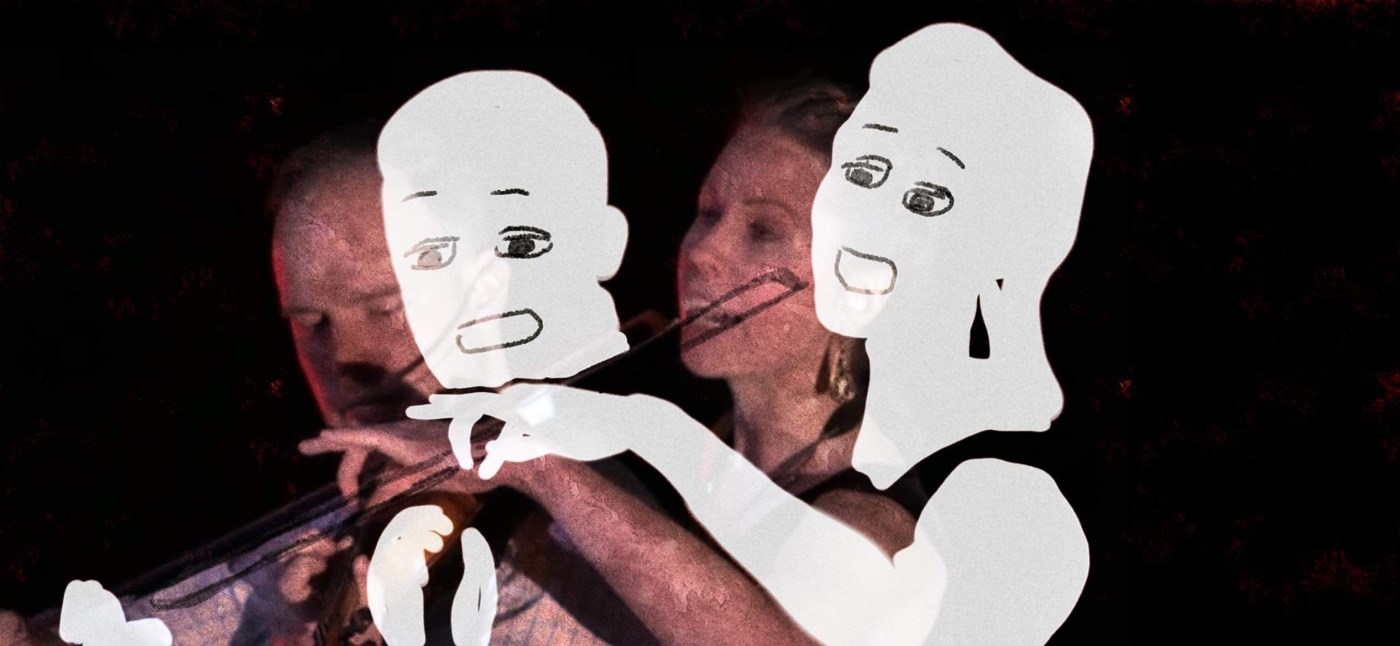
There is a moment in American composer Kate Soper’s philosophy-opera IPSA DIXIT (2016) when Soper, in her role as prima donna, walks over to violinist Josh Modney and begins a strange assault on his violin. Specifically, she fingers notes on the fingerboard while he bows, creating harmonies and sonorities that would not be achievable by a single player.
What might be an act of violence against Modney’s performative persona, however, is complicated when he, too, exceeds his usual timbral space. He speaks words from the same text as Soper (Freud, because of course) – the same passage, even. The performers, seem, in other words, temporarily to fuse into a single being with a single mind and a single dramatic goal.
In Greek mythology, the Chimera was a many-headed fire-breathing lion-goat hybrid whose close relatives included the three-headed dog Cerberus and a sea monster with an irritating proclivity for regrowing its numerous heads, the Hydra. Biologists use the word chimera to refer to any organism that exhibits more than one genotype. This phenomenon can happen in humans if a foetus ‘absorbs’ its twin in the womb.
In IPSA DIXIT, I find both of these chimeras. The two-headed Soper-Modney singing violinist is, on the one hand, a strange bicephalous monster that spews music and Freud in place of fire. On the other hand, the foetuses of the two musicians’ individualities seem to absorb one another; they sacrifice their individual authorial control for the production of a transpersonal creativity.
I am reminded of another chimeric entity in the work of Marina Abramović and Uwe Laysiepen (who went by the mononym Ulay). From 1976 to 1988, these two pioneering performance artists worked together to explore the concepts of self, ego, and artistic identity. Ultimately, they came to consider themselves a single, collective being which they dubbed ‘The Other’. They began to dress and act like twins, and conceived of themselves as parts of a two-headed body.
As The Other, Abramović and Ulay gave a performance titled AAA-AAA (1978), in which they faced each other while making long, wailing vocal sounds. Gradually they stepped closer and closer together until they were singing straight into each other’s mouths (watch a snippet here).
In trying to understand this dynamic, I stumbled across Ancient Greek ‘emission theories’ of sight, which conceived the eye as shooting out ‘eyebeams’ that land on their surroundings. Thus, for such people as Euclid and Ptolemy, to look upon something was to make a claim on it. Though modern science has refuted this theory, Abramović and Ulay seem to provide an auditory analogue, as each of them sends out a ‘voicebeam’ to absorb the other within their own self.
But sound is not as personal as sight – once vented from the body, like a gas it swells to fill the space in which it exists. The two performers thrust themselves into a reverberant echo chamber, penetrated by their own voice as much as that of the other performer. When confronted with one’s own alienly disembodied voice in the resultant cacophony, the self cannot help but become diffused. Psychologists have identified the phenomenon of ‘vocal confrontation’, whereby hearing one’s own voice produces an uncanny effect (the reason we hate our own voices in recording). It is an othering of the self.
Both of these chimeras (Soper-Modney and Abramović-Ulay) dislodge the stable kernel of creative control that is the ego. By conjuring a centre of production that exists somewhere between two bodies, they both succeed in complicating our assumption that authorship emanates simply from individuals. The notion of ‘a composer’ seems somewhat inappropriate in these situations; the act of creation has become fluid, the product of some unique relational dynamic. That is not to say that all composerly authority has been vanquished (the author is, at least, still breathing), but rather that it becomes impossible to make the simple equation between creator and ego upon which the traditional, singular model of ‘the composer’ is predicated.
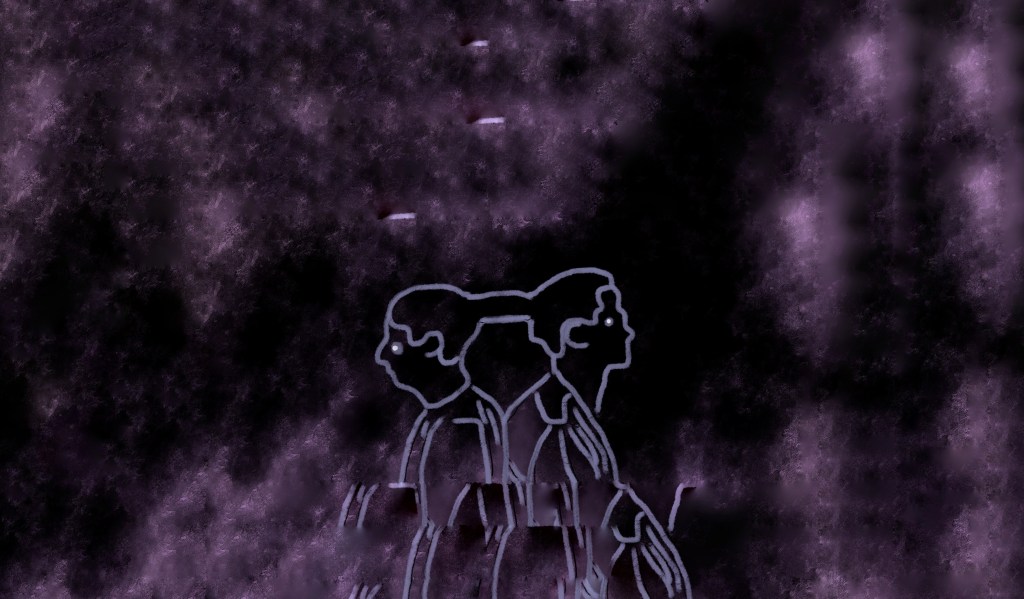
‘The Other’; artwork by Jess Abrahams

 RAMpage