
By Kennedy Blair Miller
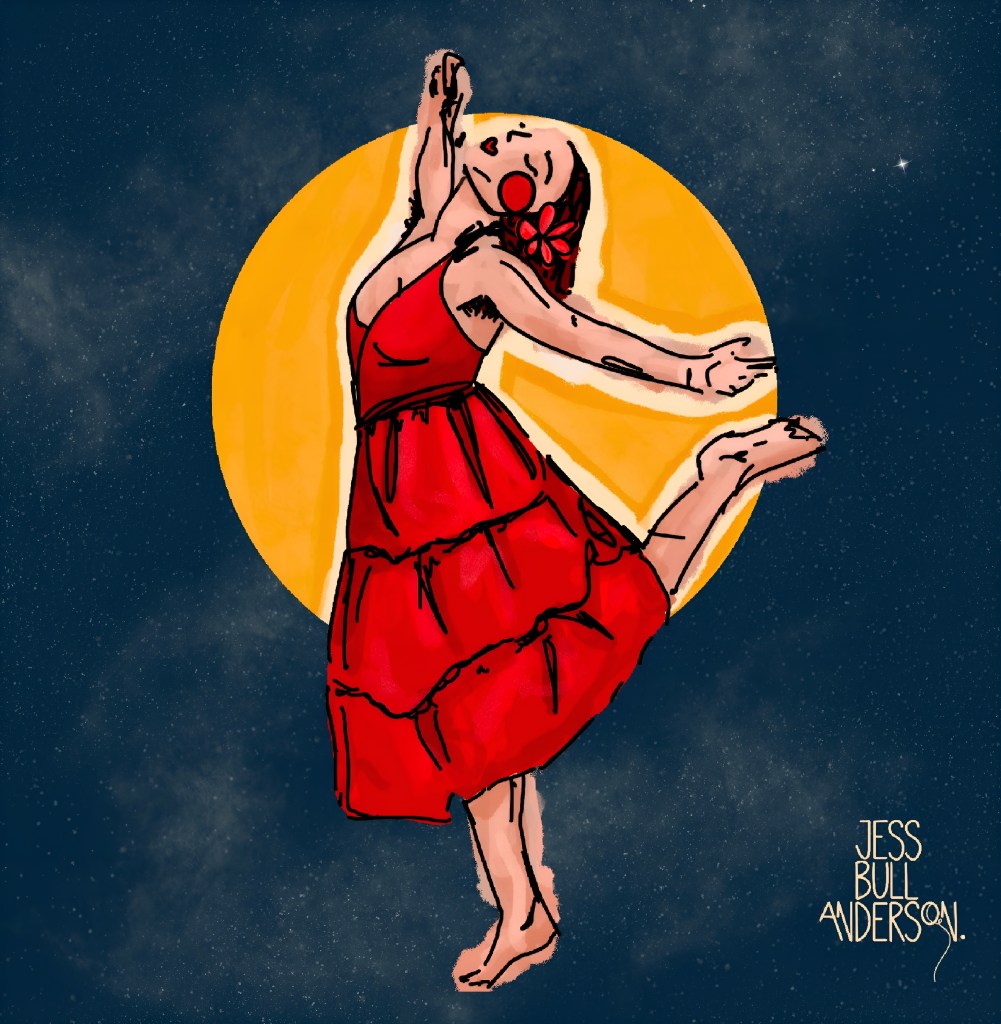
Artwork by Jess Bull Anderson
The doors to the Opéra-Comique theatre opened to a bustling crowd of eager Parisians on 3 March 1875. Well-dressed socialites, composers, and artists presented their tickets to the ushers with an air of superiority. They had been invited to the premiere of a new opera, Carmen, written by Georges Bizet, the young rising star of the French music scene.
Bizet had considerable reason to believe the opera would be a success. For one, the novella by Prosper Mérimée on which the opera was based, also entitled Carmen, was a tremendous hit after it was published in 1845. Set in Spain, this was an “exotic” story about a seductive and villainous Roma named Carmen who corrupts a good Spanish soldier named Don José, who murders her at the novella’s climax in a crime of passion. There was a great demand among nineteenth-century French audiences for these types of stories and settings; the country’s colonising spree over the prior centuries led to an influx of travelogues and other literature set outside France. Andalusia, the setting of the novella, is the Southernmost region of Spain and the most proximate to Africa, where France had recently colonised Algeria in 1830. From her inception, Carmen is racially othered, an identity that, despite not being explicitly explored in the opera, informed the nineteenth-century French audience’s perception of her given their context of the novella. The Islamic-influenced Andalusian music that Bizet wove into the opera, joined with Carmen’s sensuality, reflected how the French perceived Algerian women in their art and literature.
Bizet’s confidence in the opera’s success was not shared by the opera’s librettists, Henri Melihac and Ludovic Halévy, who shared concern over their leading lady, Celeste Galli-Marié, a renowned French mezzo-soprano. Not only had Celeste demanded that Bizet rewrite her classic Act I aria, the “Habañera,” thirteen times, but she decided to undertake the role with an air of realism that was not common in the opéra-comique style to which Carmen belonged. Not to be confused with the name of the theatre where Carmen premiered, opéra-comique was a genre of operas in which performers often took on roles with an air of parody and lightness. Such an air would have been expected in the portrayal of Carmen, a working-class woman working at a tobacco factory and doing tarot readings. However, Celeste wanted to experiment with a more dramatic and realistic performance practice, leaning into Carmen’s sultry and cunning habits. This made the librettists nervous. They already considered it risky to offer a platform to a character like Carmen, who unapologetically lives a life of sexual freedom and untamable independence. Thus, she might offend the conservative French audiences if she were portrayed too realistically. Carmen needed to be laughable in the style of opéra-comique. But Celeste refused to accommodate their demands.
Melihac’s and Halévy’s concerns were not unfounded. Carmen was a massive hit when she was restricted by the pages of the novella – Carmen is silenced, and this made the story safe. By the time Don José recalls the story of Carmen in the novella, which is told solely from his perspective, she has already been murdered; thus, she is a conquered villain who cannot defend her own story. Seeing Carmen brought to life on a stage by a sexy, confident woman who wears her strapless corset tight and sings her dark, mezzo voice with colours of seduction was to give this dangerous woman a voice and a platform. To lift her from the page innately to give her power. Suddenly, Carmen was occupying real space in a visual world where she had a voice and an audience.
The critics’ responses in the newspapers the next day were brutal, but they were less focused on Bizet’s music than they were on the offensive nature of the protagonist herself. One indignant critic wished the director had instructed Don José to give Carmen “a good kicking” before stabbing her to death in Act IV. At least five commented on Celeste’s “too realistic” portrayal of Carmen, saying that bringing a “prostitute to life” was an offence to good French society. Another said that the Carmen onstage was a much different, and a much more dangerous, game than the Carmen on the page.
I saw Carmen at the Houston Grand Opera in 2021. The audience cheered when Carmen entered barefoot and with a rose in her hair to sing her “Habañera”, but in Paris on 3 March 1875, they gasped. The audience smiled when she told Don José that she’d never commit to him, but in Paris on 3 March 1875, they grumbled with discontent. The audience wept when she was killed, but in Paris on 3 March 1875, they sat in frigid, accepting silence.
How did she do it? How did Carmen come back to life and avenge her legacy?
For one, French society was forced to change as women demanded the right to vote, to divorce, to be economically independent, and to be sexually liberated. They made quick work. One century after Celeste shocked audiences by being and portraying an unapologetic, empowered woman, the UN declared 1975 “The Year of the Woman” to celebrate unapologetic, empowered women.
Here’s another theory: Maybe the empowered women that we study in history and that we meet and learn from in our lifetimes set a precedent for how we portray and perceive empowered women on stage. Maybe Carmen has evolved into this symbol of female autonomy because Celeste Galli-Marié demanded that Bizet rewrite thirteen times what would become one of the most famous classical music pieces of all time; or because she chose to say no to the men who demanded her to be tame and subtle in her performance practice; or because Algerian women bravely fought alongside their male counterparts in an eight-year war of independence against France; or because the second wave French feminists passed out brochures with declarations of sexual liberation. Carmen came to life because women breathed life and power into her.
May dangerous women continue to resurrect ourselves and one another. Long, long live.
Bibliography
Prosper Mérimée [trans. W. P. Baines], 2012, Carmen (New York: Simon and Schuster).
Clair Rowden & Richard Langham Smith, 2020. Carmen Abroad: Bizet’s Opera on the Global Stage. (Cambridge: Cambridge University Press).

 RAMpage